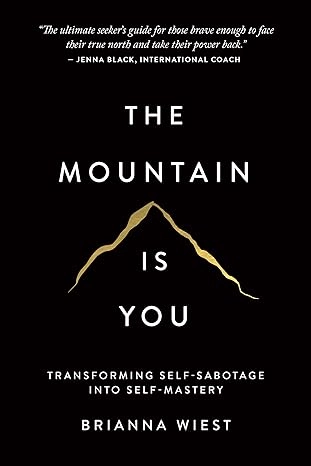
The Mountain Is You by Brianna Wiest
By Susie Bennett
Published on 5 February 2026
On This Page
Rating: 4/5
Brianna Wiest’s The Mountain Is You arrives with a provocative central idea: often, the biggest obstacle in our lives isn’t external circumstances, difficult relationships, or career challenges. Instead, it is the accumulated weight of our own self-sabotaging patterns — and the path forward requires us to face them.
What the book gets right
Wiest’s greatest strength lies in how clearly she captures the internal experience of feeling stuck. She describes self-sabotage not as weakness or failure, but as a psychological strategy that once protected us, even if it now creates problems.
The book explores how we unconsciously recreate familiar discomfort because it feels safer than change, how we resist opportunities we claim to want because they threaten our identity, and how defence mechanisms can quietly become prisons. These ideas are well established in psychology, but Wiest presents them in language that feels accessible without becoming simplistic.
Her concept of “middle problems” is particularly insightful. We often fixate on practical obstacles — not enough time, not enough confidence, not enough resources — rather than confronting the deeper issue beneath. Once named, this pattern is hard to unsee.
The book also draws an important distinction between self-awareness and self-obsession. Growth, Wiest argues, isn’t about endlessly analysing ourselves but about eventually taking action. In a culture saturated with self-improvement advice, this reminder feels refreshing.
The Instagram aesthetic
The book grew out of Wiest’s writing on social media, and this influence shows. The writing is quotable, digestible, and emotionally resonant. Many readers will find themselves underlining passages that articulate feelings they’ve struggled to express.
However, this strength can sometimes become a limitation. Complex psychological ideas are occasionally presented as definitive truths without much nuance. The tone can slip into prescriptive territory — suggesting there is only one path forward — which doesn’t always reflect the messy complexity of real life.
Structurally, the book feels more like a collection of connected reflections than a tightly argued thesis. Some readers will enjoy this flexibility, while others may wish for a more systematic approach.
The self-help double bind
Books about self-sabotage carry an inherent risk: they can easily become another source of self-criticism. Wiest generally avoids this by emphasising compassion and understanding.
Still, the central message — that we create many of our own obstacles — may land heavily for readers already inclined toward self-blame.
This matters particularly where external pressures genuinely exist. While Wiest acknowledges real-world barriers, the focus on internal change can unintentionally minimise systemic or economic challenges people face. Personal responsibility is important, but it isn’t the whole story.
Who this book serves best
The Mountain Is You is likely to resonate most with readers who:
- Recognise they’re stuck in repeating patterns but struggle to see why
- Need encouragement to move from reflection into action
- Respond well to direct, assertive motivation
- Are ready to examine their own role in current circumstances without ignoring external realities
- Prefer accessible psychological insights over academic detail
It may be less helpful for readers who:
- Want research-driven, evidence-based approaches
- Need step-by-step behavioural strategies
- Are dealing with significant trauma or mental health challenges
- Feel sceptical of personal development writing and prefer a more critical perspective
The verdict
The Mountain Is You probably won’t transform your understanding of psychology, and it doesn’t try to. What it offers instead is a compassionate but sometimes challenging mirror, helping readers notice the patterns keeping them stuck.
Wiest writes with conviction, and for many readers that clarity will be motivating. The book’s power lies not in originality but in helping people recognise themselves and feel encouraged to move forward.
It works best as a starting point rather than a complete guide. Let it prompt reflection and motivation, but pair it with deeper resources if you’re tackling complex behavioural change. And perhaps most importantly, hold its message lightly enough that it supports growth rather than becoming another source of pressure.
The mountain may be you — but you are also the climber, the path, and eventually, the view from the top.
Key takeaways
- Self-sabotage often began as protection that is no longer needed
- Resistance to change frequently reflects fear of losing identity or safety
- Genuine self-awareness leads to action, not endless analysis
- Obstacles we see as external may also have internal roots worth examining
- Moving forward requires both understanding our patterns and trying something different
Rating: 4/5